
Images of Planet Earth from Space
Images of Planet Earth from space were taken from different sources and satellites, mostly published by NASA, which is an exploration agency. The Earth's structure consists of a solid inner core, a liquid outer core, a thick, molten mantle, and a crust.
The lithosphere is the Earth's crust and upper mantle, which is divided into tectonic plates that are constantly moving, causing phenomena, like earthquakes and volcanic eruptions.
Planet Earth science, or geoscience, is the study of Earth's physical, chemical, and biological components, encompassing its entire system, including the land, water, and air. It explores the planet's formation, its internal processes like plate tectonics and volcanism, its diverse ecosystems, and the interconnected relationships between its four main spheres: the geosphere (land), hydrosphere (water), atmosphere (air), and biosphere (life).
NASA's Earth Science Division operates more than 20 satellites in orbit, sponsors hundreds of research programs and studies, and funds opportunities to put data to use for societal needs. It develops new ways to observe the oceans, land cover, ice, atmosphere, and life, and we measure how changes in one drive changes in others over the short and long term.


Photograph taken from the Apollo 7 spacecraft in the morning Sun, on October 20, 1968, showing the State of Florida and the Gulf of Mexico, looking southeast, released by NASA. Apollo 7 was the first manned space mission of the Apollo program, launched on October 11, 1968, and successfully tested the Apollo Command and Service Module in Earth orbit, paving the way for future lunar missions.





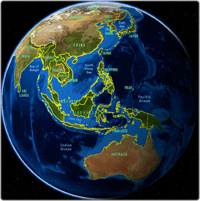
Eastern Indian Ocean on October 21, 2019, composite image from NASA, showing Australia and South Asia.





|
Copyright © Geographic Guide - World in Pictures. African Continent. |

Images of Planet Earth from Space

